

Creature Features and Horror Hosts
The starting place for Gen X horror lovers (and Boomers too)

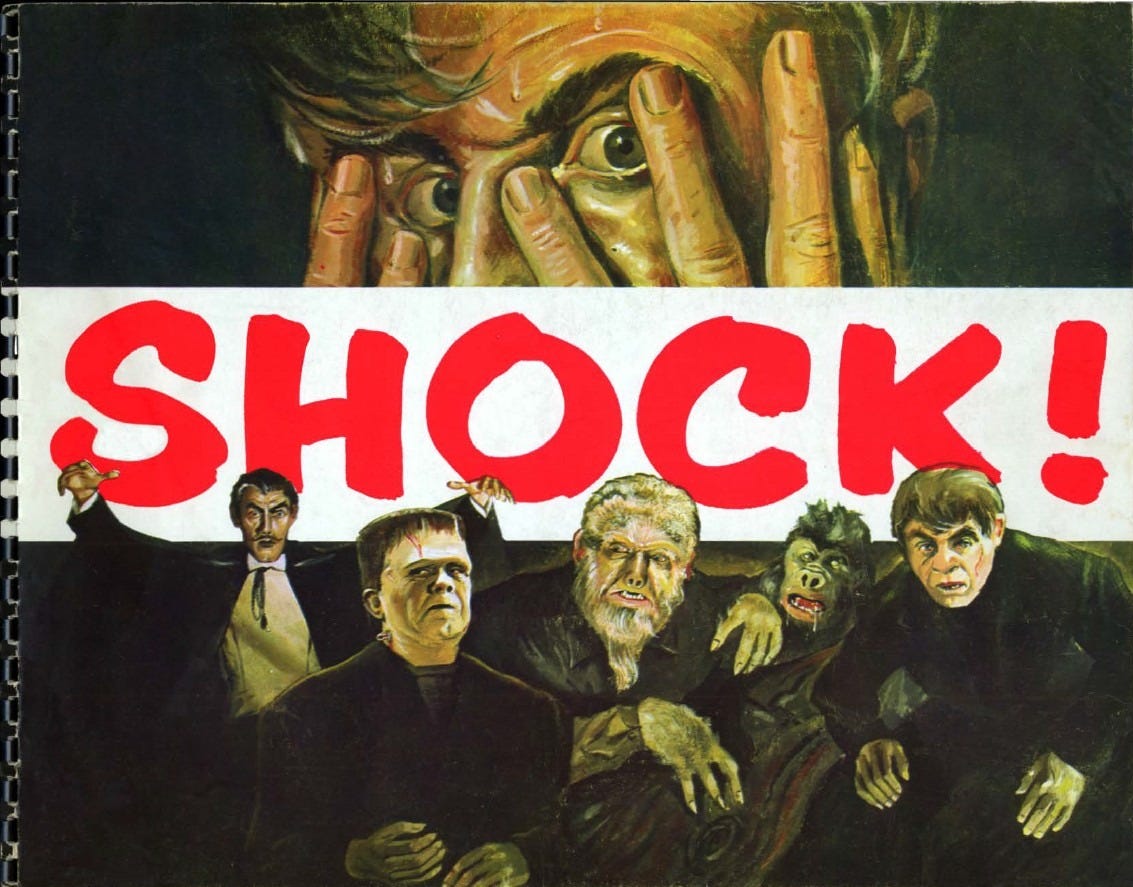
Saturday afternoon, local cable, a made-up, costumed horror host, and a bevvy of classic shockers.
The pattern is a familiar one to those of us of a certain age.
It was where we first saw Dracula and Abbott and Costello met Frankenstein, where we got our first glimpse of Hammer’s Christopher Lee and Peter Cushing, where we first understood the vivid, lurid power of blood red splashed in Eastmancolor dye-transfer Technicolor.
Across the US, there were regional horror hosts in every market. Before the days of Mystery Science Theater 3000, before Joe Bob Briggs and mail girl Darcy, even before Elvira, there was Zacherley, Ghoulardi, Chilly Bill Cardille, Vampira, The Great Zucchini, Dr. Creep, and The Cool Ghoul.
And then there were the horror packages.
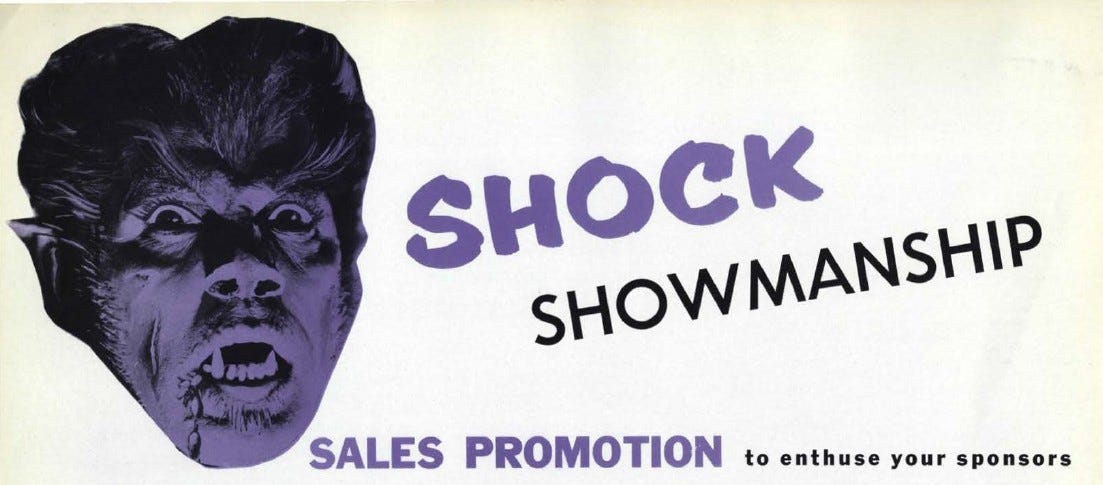
In 1957, Screen Gems acquired the rights to 52 Universal horror films, bringing to television the classic Dracula, Frankenstein and Mummy films. Their “Shock!” package was the first syndicated collection of horror films, meant for late nights and Saturday afternoon marathons.
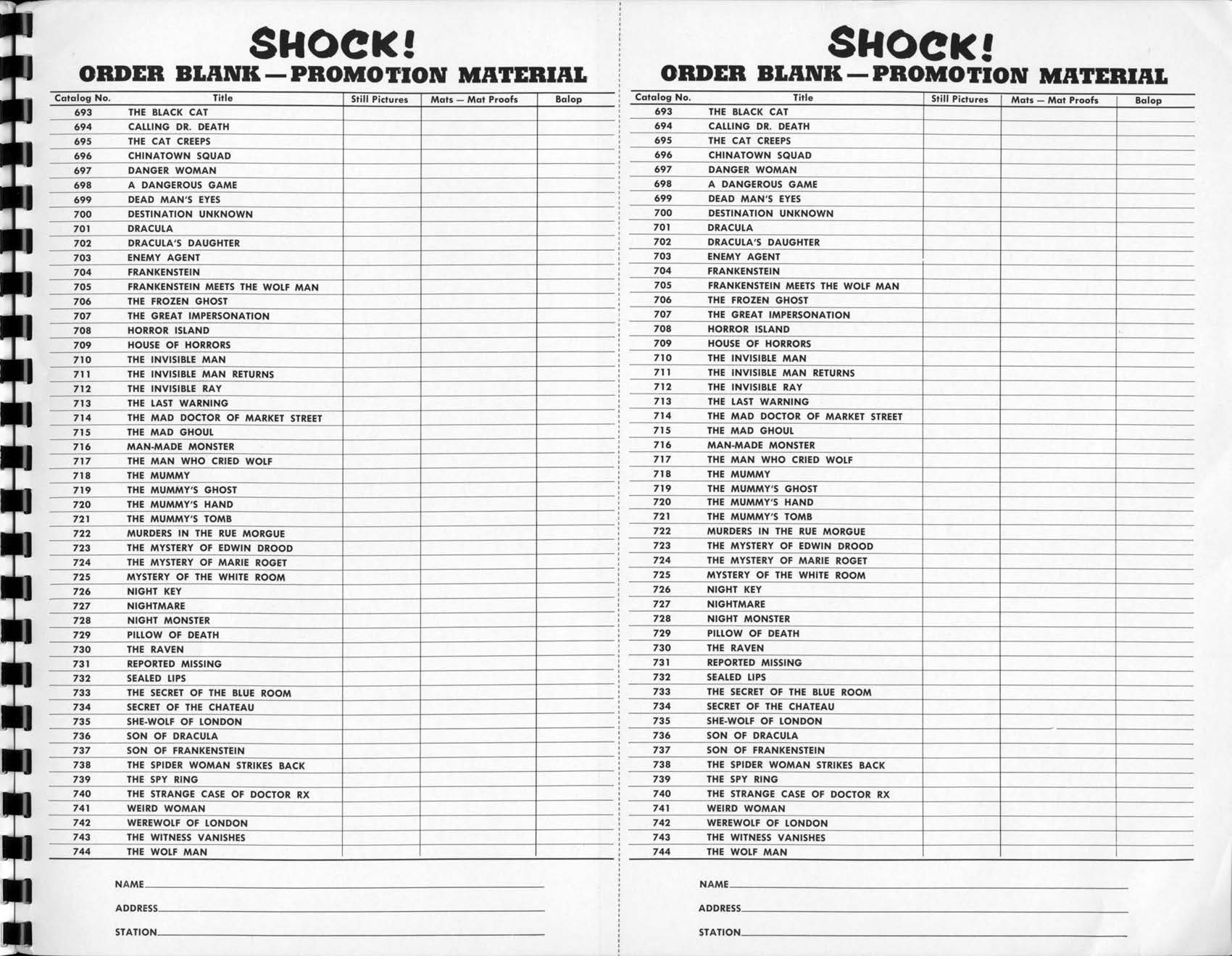
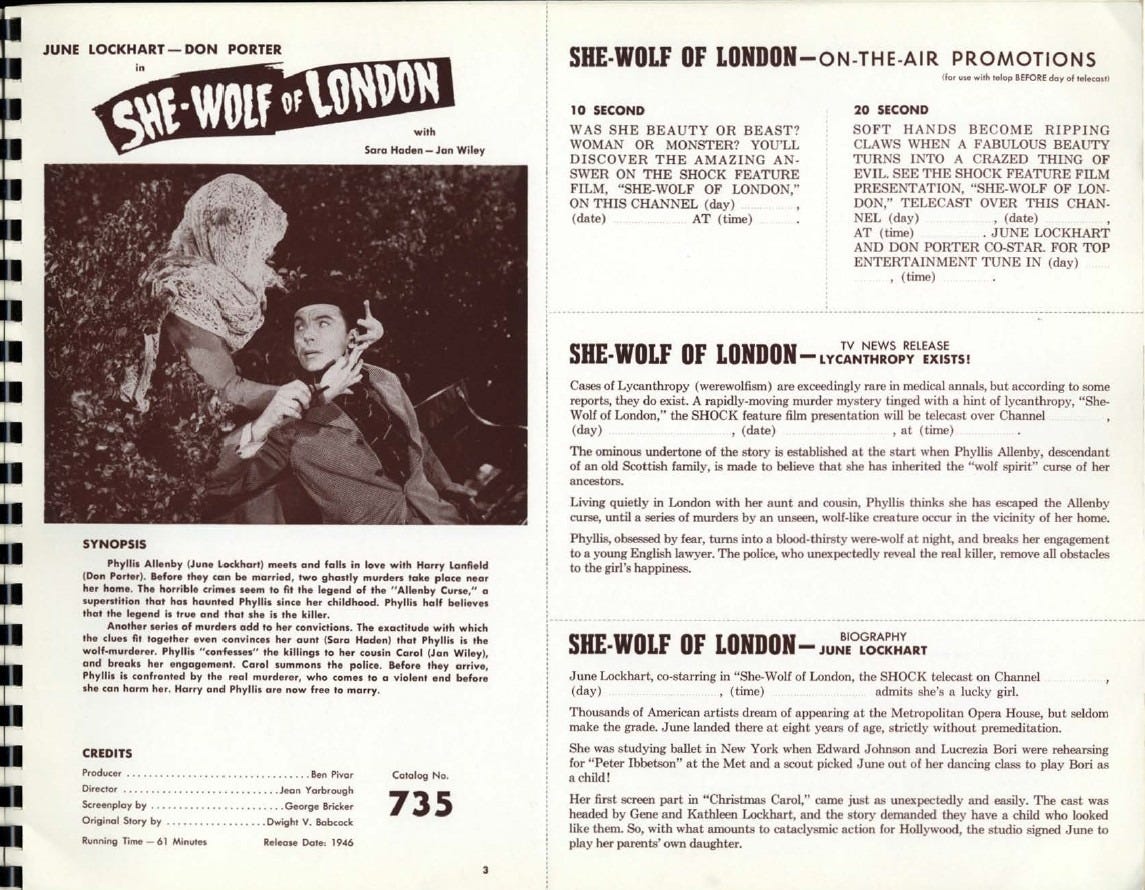
The marketing materials originally released for the Screen Gems Shock! Package are a revelation, and not just because they were sitting there in the Internet Archive the whole time.
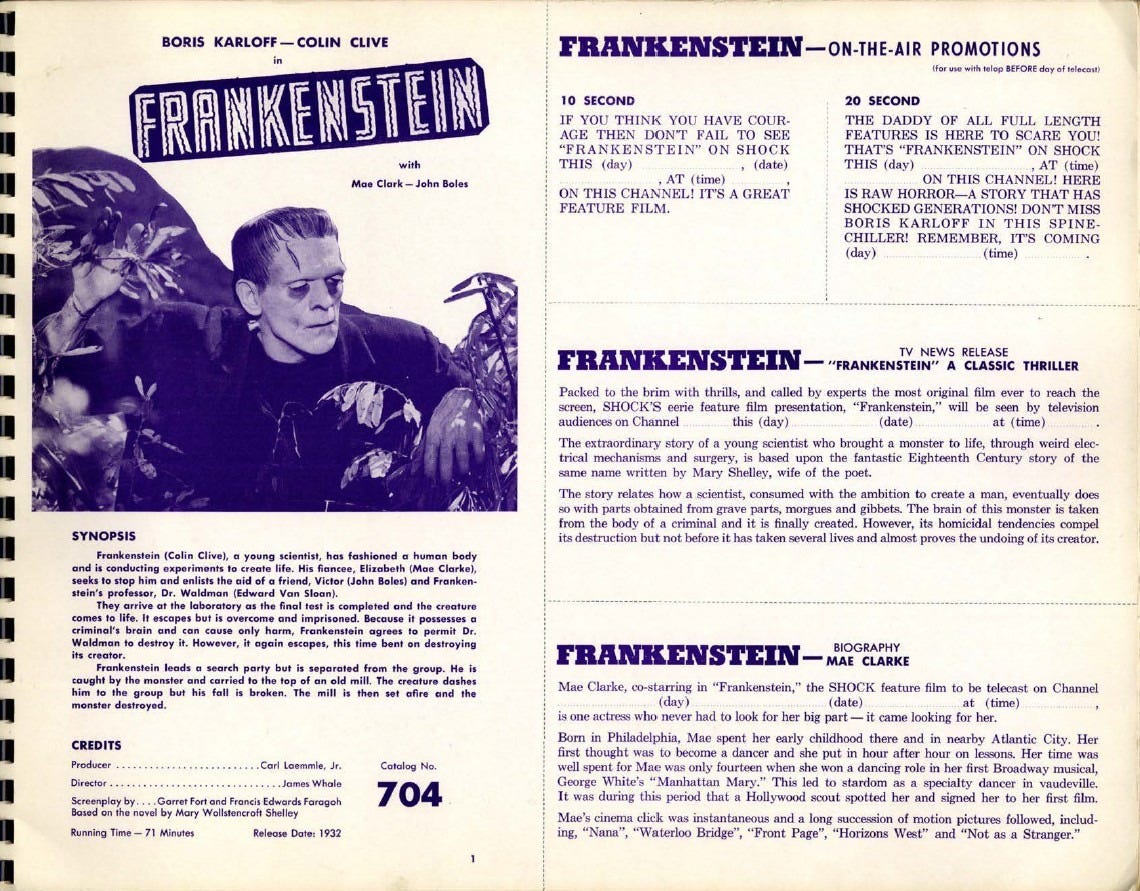
Note the ad copy for radio and TV, and TV Guide news release.
Many of the generation just before me got their first taste of classic movie monsters with these syndicated packages. My generation — I was born in 1970 — followed on with similarly curated collections.
And in regional markets, TV stations hired local talent to introduce the movies.
And hence, the horror host was born.
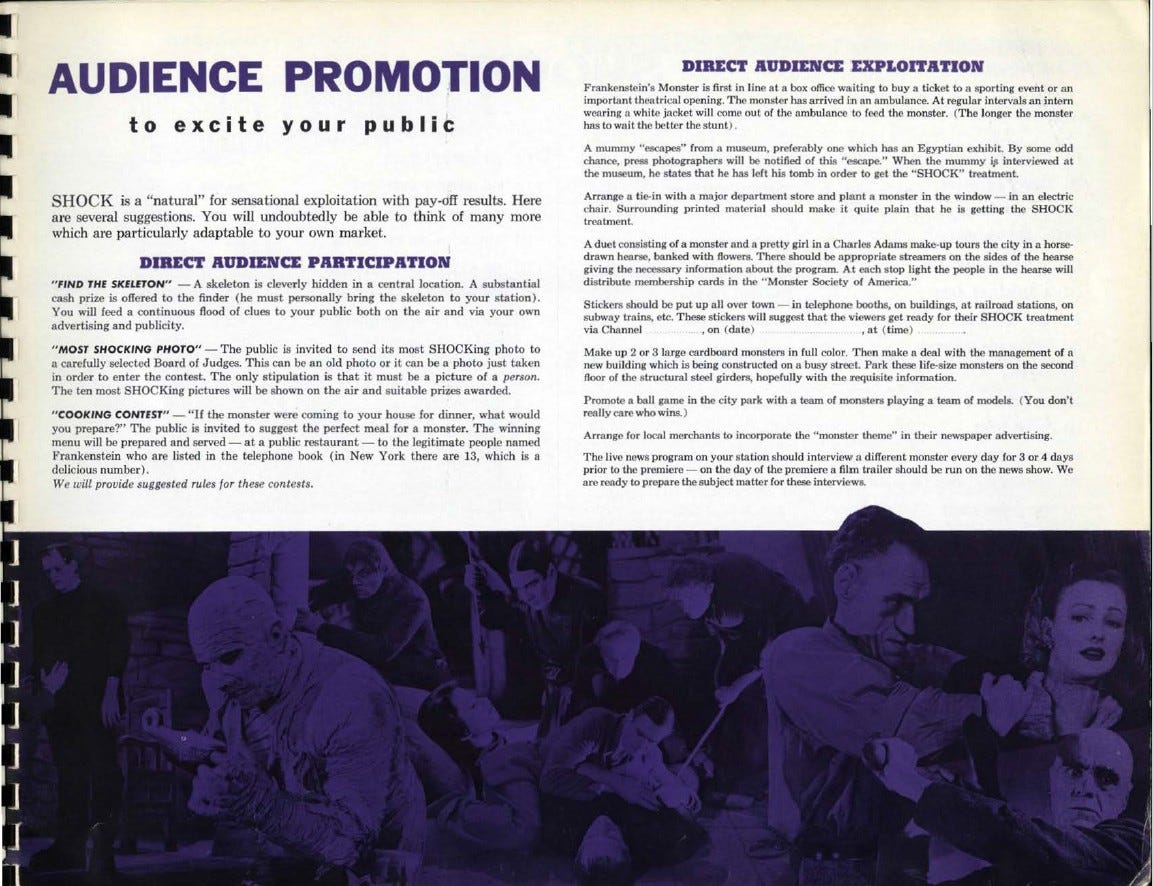
Even in the marketing materials made available, dressing up locally as the monster du jour was recommended, and encouraged. The birth of the horror host, via instructions.
Predating even the Shock! catalog, of course, was Vampira (Maila Nurmi); famed for her original presentations of horror movies on KABC in Los Angeles, as well as her starring role in Ed Wood Jr.’s Plan 9 From Outer Space. Lisa Marie would do her corset justice in Tim Burton’s Ed Wood.
Next up was Zacherley (also known as the undertaker Roland), or John Zacherle, hosting Shock Theater in New York and Philadelphia. Taking this new syndicated package to the airwaves, he tackled a thankless job with a thankless haircut on a pitiable budget. And had a blast.
There’s a pretty amazingly robust directory of horror hosts by state online, but it’s an archive of a site long gone.
For a few years running, there was an annual awards ceremony for the horror host hall of fame, celebrating horror hosts new and old alike.
In your market it could have been Sci-Fi Theater or Chiller Theater or Count Dracula Presents. Regardless, the collections had regionally generated intros and titles, eagerly awaited by 12 year olds across the nation.
Bob Wilkins was the mild-mannered host of KTVU San Francisco’s Creature Features selection.
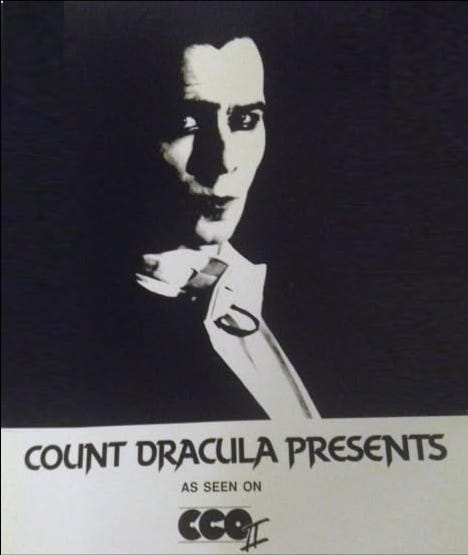
In my hometown in Lakeville, Minnesota, a southern farm suburb of Minneapolis, Saturday night was spent with Jake Esau as Count Dracula on WCCO II, where he presented the more mundane Universal and related creature pictures. Afterwards you’d get the rougher stuff, from Mario Bava’s Blood and Black Lace to Alan Rudolph’s exploding cow- and Hoyt Axton movie Endangered Species.
Of course, just up the UHF dial in Minneapolis, soon enough KTMA was broadcasting the first ever MST3K season in its nascent form.
In threads on Reddit, you can read personal memories about horror hosts in every region, from Dr. Paul Bearer in Tampa to Morgus the Magnificent in New Orleans.
In the 80s, the regional horror hosts went national as cable proliferated, whether it was Rhonda Shear on USA Network’s Up All Night, or Elvira, or Joe Bob Briggs, or USA’s companion piece, Night Flight’s endless parade of horror flicks, rock n roll, and sometimes both (the less said about Rock ’N’ Roll Nightmare, the better).
As the 80s wore on, the simple joys of nostalgic monster movies gave way to slashers and gimmicks. 3-D came roaring back briefly, first in theaters with exploitation flicks like the Italian and rough Comin’ At Ya to Metalstorm: The Desctruction of Jared Syn, to bigger, but not necessarily better, releases like Jaws 3-D and Friday the Thirteenth part 3 in 3-D.
You haven’t lived til you’ve seen the Jaws shark swim through a shattering window straight at you. Well, straight at Dennis Quaid.
Trying to figure out which syndication packages had which movies is a complicated and overlapping question.
In many cases, the American studio that was involved in distribution — for instance, in the case of the British Hammer horror pictures — had the syndication rights for television. Seven Arts had co-financed many Hammer productions and was involved in 18 Hammer Films productions, according to Wikipedia. When Seven Arts acquired Warner Bros. in 1967, those Hammer titles entered the Warner television library, where many theortically remain today.
And Hammer films distributed by Universal (including titles like The Evil of Frankenstein, Brides of Dracula, Kiss of the Vampire, Night Creatures, and others from their early-1960s deal) entered Universal's television syndication pool.
Hammer is currently undergoing a bit of a renaissance under CEO John Gore, releasing gorgeous reissues of films in extended box sets, but it’s unclear how this extends to television syndication or streaming rights.
In the early 1960s, Screen Gems added to the monster mash with a “Creature Features” package — expanded again in the 80s — that added science fiction, British horror and Japanese kaiju.
Meanwhile, American International Pictures (AIP), home to Roger Corman’s cadre of cheapies, was promoting their packages of syndicated films, rolling out titles like Invasion of the Saucer-Men and Attack of the Mushroom People.
And as rights became available, stations were able to pick up more Hammer pictures, and even the arguably lesser anthologies from Amicus and Tigon, like Dr. Terror’s House of Horrors.
As the content proliferated, so did the horror hosts, region by region.
The famed host Ghoulardi is better known by his real name, Ernie Anderson, familiar to some as the father of One Battle After Another director Paul Thomas Anderson.
The Creature Feature name wasn’t just the property of Chilly Bill Cardille in Pittsburgh. (Chilly Bill would have a prominent role in Night of the Living Dead as a TV reporter.) In other cities. under the same Creature Feature name, costumed hosts like Count Gore de Vol in D.C. held court.
Other Regional Hosts of Note:
Northeast and Mid‑Atlantic
New York City – WNEW‑TV Channel 5 (Metromedia) - Ran *Creature Features* as a classic horror‑film show for the New York metropolitan area, hosted by announcer Lou Steele (“The Creep”).
Buffalo – WUTV‑TV Channel 29 - A version of *Creature Feature* began on WUTV in 1971, first on Saturday, later Fridays, mixing Japanese kaiju, AIP titles and other B‑movies.
Philadelphia – WKBS‑TV Channel 48 - A Kaiser/Field station that imported a successful New England *Creature Double Feature* concept and aired it between 1976 and 1979, effectively filling the same niche for that market.
Midwest and Great Lakes
Chicago – WGN‑TV Channel 9 - Launched *Creature Features* in the fall of 1970; it ran to 1976, using Henry Mancini’s “Experiment in Terror” as theme music and presenting horror/sci‑fi features with an off‑screen “Creature” voice.
Omaha – KMTV‑TV Channel 3 - A long‑running *Creature Feature* aired from 1971 to 1983, hosted by Dr. San Guinary (John Jones), and later revived locally in the 2000s and 2010s.
South Bend – WSJV‑TV Channel 28 - A Saturday‑night *Creature Features* ran from 1968 to 1977 for the South Bend, Indiana metro area, using distinctive monster‑head artwork and castle imagery in its graphics.
Kansas City – KSHB‑TV Channel 41 - A late‑night horror show under the *Creature Features* title ran from 1981 to 1990, hosted by Crematia Mortem (Roberta Solomon) before the title shifted to Crematia’s Friday Nightmare.
West Coast and Mountain
San Francisco Bay Area – KTVU‑TV Channel 2 (Oakland) - One of the most famous incarnations of *Creature Features* aired on KTVU from 1971 to 1984, first with Bob Wilkins and later John Stanley, combining films with interviews and fan‑culture segments.
South and Southeast
Tampa–St. Petersburg – WTOG‑TV Channel 44 - Ran *Creature Feature* from 1973 until 1995, hosted by Dr. Paul Bearer (Dick Bennick Sr.), often cited as one of the longest‑running *Creature Feature* franchises in the U.S.
Miami/Ft. Lauderdale – WCIX‑TV Channel 6 - A Creature Feature slot aired in the early 1970s (late 1972–early 1973), hosted by local radio personality Arnie Warren and his beagle Amos, usually in a late‑night Friday slot.
Regional “Acri Creature Feature” syndication - Although not a single national show, Phil/Chuck Acri’s “Acri Creature Feature” was marketed from the Quad Cities to multiple Midwestern outlets, giving it unusually wide regional reach for a “local” horror program. Stations carrying this branded package included KCRG (Cedar Rapids), WEEK (Peoria) and WICS (Springfield), showing how creature‑feature programming could spread beyond a single home market.
Thanks for digging into syndicated horror and costumed hosts with me this week!
As usual you can get in touch at nicholas@ghostguide.co
You can find me at https://ghostguide.co - your ultimate streaming guide to horror and genre film!
And all of this stuff I’m doing is supported by you. Your helpful donations - in the form of a delicious cup of coffee — keep this thing on the rails.
How neat! I often forget how expansive movie hosts were. This was a fun read!
Bob Wilkins on Channel 2's Creature Features was the man. There was somebody on a Sacto station as well, but I don't remember...