

The Popular Auteur
Álex de la Iglesia and the miracle of the great filmmaker who "can't make a decent film"

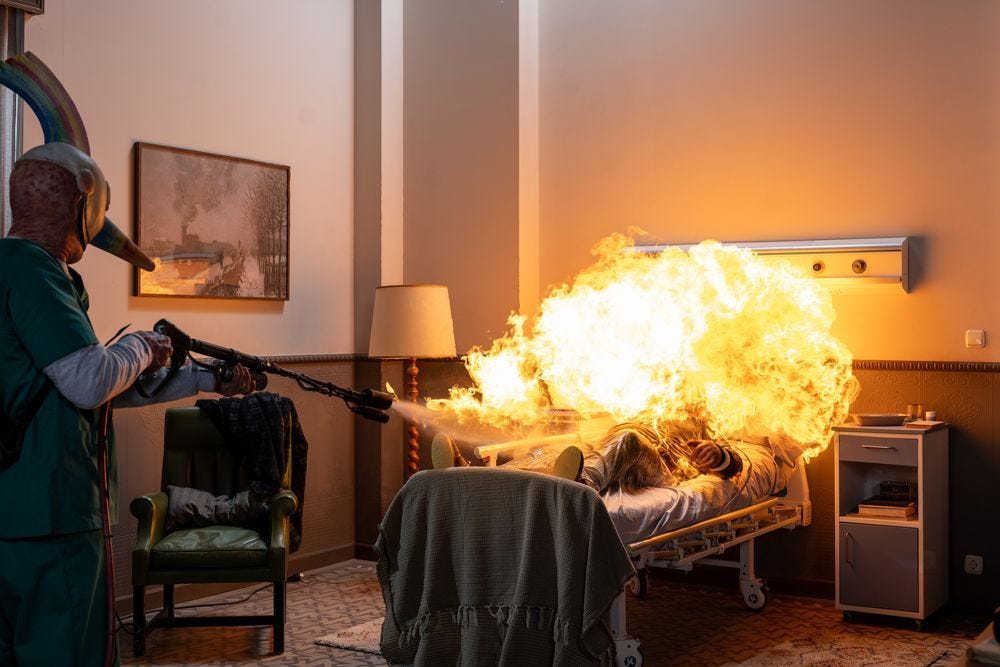
Is it possible to be a great filmmaker and yet never make a good film?
That is the mercurial promise and threat of the Spanish “popular auteur” Álex de la Iglesia.
At least, the one posed by his critics and biographers.
In his films, since 1993’s Accion Mutante, and leading all the way to his episodic 30 Coins on HBO Max, canceled after season 2 but with an entire 3rd season ready to film if conditions improve, Álex de la Iglesia has sculpted an entirely effective and clearly auteurist vision, one equal parts Jean-Pierre Jeunet and Terry Gilliam.
With ample room for horror and black comedy.
The writer Tomas Fernandez Valenti – a Spanish film critic and lawyer of some renown - writes of Alex de la Iglesia, “Since (he) is the most talented film-maker of his generations, he could make better things than he has so far – provided that he does not give in so easily to puerility; La Comunidad, for example, is too lacking in maturity to be consistently good.
To put an even finer point on it, the writers of The Cinema of Alex de la Iglesia argue, “The frustration with De La Iglesia, who is apparently an auteur who refuses to conform to the qualities of the auteur, is captured perfectly in (the claim) that De La Iglesia is at once the most accomplished film-maker of his generation, and has failed yet to make a decent film.”
Strange paradox, indeed.
Of course this is all ballyhoo. De la Iglesia has made some spectacular pictures, and continues to make them at seemingly increasing speed.
In Spain there is the concept of the “Popular Auteur.” This is the phrase for a director with a keen sense of style and visual and narrative voice, but who nonetheless trafficks in pop culture and disposable cinema.
There couldn’t be a more appropriate name for the thing that I love.
I’d been focusing on a series about what I was calling “Working Directors” - folks like Grosse Point Blank’s George Armitage or horror philosopher Larry Cohen or workaday movie directors who have since moved into television, like The Changeling’s Peter Medak or Glengarry Glen Ross’s James Foley.
These are likely names that don’t exactly light up the memory banks, unless you’re a credits obsessive like me.
One of the more natively successful directors of the past 30 years in Spain is de la Iglesia.
De la Iglesia appeared at a time in Spain of upheaval, as post-Franco freedom and business conditions shifted the winds.
His first film, Acción Mutante (1993) is a cartoonish saga of disabled warriors fighting the aesthetic elite. It’s remembered as much for its logo as for its cabal of beautifully ugly mutante and darkest dark comedy.

It was his second movie, The Day of the Beast (1995), that really caught people’s attention.
In The Day of the Beast, a priest finds an ancient algorithm that predicts the birth of the Antichrist, the day of the apocalypse. And the actual date it’s going to happen.
Which of course is “today.”
The priest sets off to murder Satan and save the world. And to find Satan he realizes the quickest path is to commit as many evil acts as possible: steal, push mimes off bridges, refuse last rites to a dying man, listen to heavy metal.
The story is as cartoonish as it sounds and boisterously irreverent.
In a twist worthy of today’s headlines, the Beast finally appears in a group of right wing agitators murdering immigrants and the homeless in the name of nationalist Madrid.
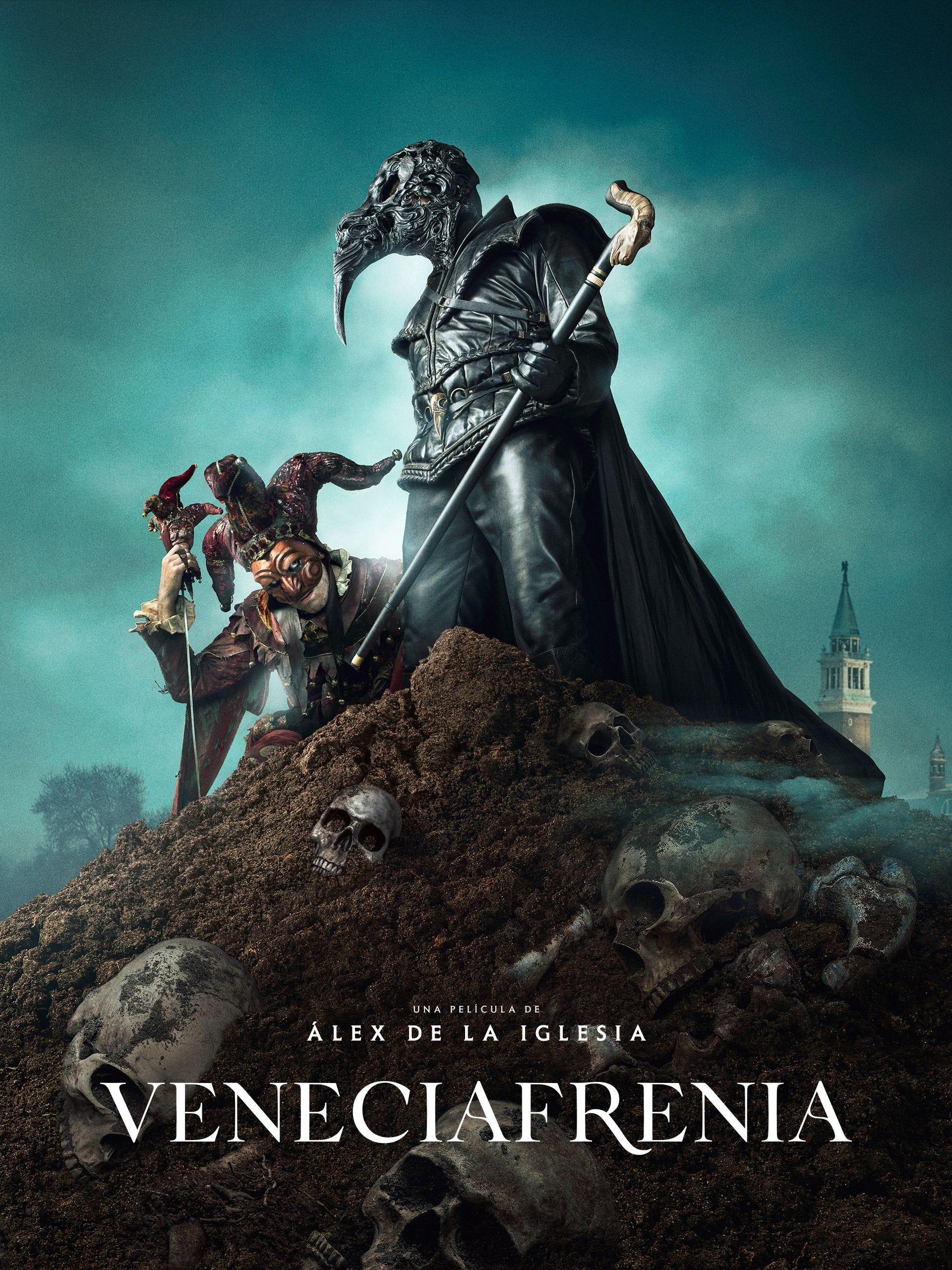
De la Iglesia’s filmography is a dense patchwork of recurring ideas and motifs.
Masks play a crucial role, whether it’s the court jester slasher in the recent Veniciafrenia (2021) (as in, Venice-phrenia, like schizophrenia), or the obscuring paint and SpongeBob masks and costumes of the obnoxious Witching and Bitching (2013).
Codes and cryptography are story elements, even if largely adolescent notions. Grand, roving camerawork keeps the films visually engaging while the narratives are mostly high concept.
Hitchcock quotes abound, clearly de la Iglesia has studied the master.
But has he also adopted Hitch’s misogyny?
Women play secondary roles here - the virginal housekeeper, the big boobed mistress, the hectoring ex-wife.
It’s clear that some of this is by and large a product of the director and writers’ very Spanish sensibility, but it also indicates why the films have, for the most part, been bigger in Spain than anywhere else.
It’s not for lack of trying.
His films are full of energy and bravado until they aren’t – some of them simply peter out, or attempt a bravura climax, only to end on a flat note.
Many of these films are European co-productions across countries, under the releasing imprimatur of a Universal or an HBO Max.
De la Iglesia’s own production company, Pokeepsie Films, has a mad roster of films and TV series in release and in production, and not just by him.
Jaume Balaguero (director of the stunning [REC] series) is also in the camp.
A tour of the production company’s website shows a heavy focus on distinctly Spanish titles. Despite copious in-roads, the director’s work seems often confined to his native soil.
Is de la Iglesia a good filmmaker? Clearly, yes.
His films all benefit from an immensely hip credits sequence aesthetic, from delicious camerawork, and from an outsider’s perspective.
So can you be a great filmmaker without ever making a good film? The question itself reveals more about critical expectations than about de la Iglesia’s actual output.
The “popular auteur” label isn’t a backhanded compliment; it’s a description of a filmmaker who refuses to choose between vision and accessibility, between style and entertainment.
De la Iglesia makes genre movies with the eye of an artist and the instincts of a showman. That some critics find this combination frustrating says more about the artificial walls we’ve built between “serious cinema” and everything else.
What de la Iglesia offers is something rarer than prestige: consistency of voice across three decades of gleefully unhinged work. The priests chasing Satan, the mutant revolutionaries, the masked killers stalking Venice: they all exist in the same gonzo universe, governed by the same rules of dark comedy and visual maximalism.
Maybe the real paradox isn’t that de la Iglesia hasn’t made a “decent” film. It’s that we keep reaching for that judgment at all when the films themselves are having too much fun to care.
Filmography:
Feature Films
Acción Mutante (1993)
El día de la bestia (The Day of the Beast, 1995)
Perdita Durango (1997)
Muertos de risa (Dying of Laughter, 1999)
La comunidad (Common Wealth, 2000)
800 balas (800 Bullets, 2002)
Crimen ferpecto (Ferpect Crime, 2004)
La habitación del niño (The Baby’s Room, 2006)
Los crímenes de Oxford (The Oxford Murders, 2008)
Balada triste de trompeta (The Last Circus, 2010)
La chispa de la vida (As Luck Would Have It, 2011)
Las brujas de Zugarramurdi (Witching & Bitching, 2013)
Mi gran noche (My Big Night, 2015)
El bar (The Bar, 2017)
Perfectos desconocidos (Perfect Strangers, 2017)
Veneciafrenia (2021)
El cuarto pasajero (The Fourth Passenger, 2022)
Television
30 Monedas (30 Coins, 2020– ) – creator & director
Historias para no dormir (select episodes, 2021 revival)
Thanks everyone for reading Ghosts in the Machine. You can reach me at nicholas@areyouexperienced.co or in the comments here.
This is entirely a labor of love, so those of you who do participate via paid subscriptions are helping more than you know.
I would argue that The Last Circus is genuinely a great movie. It's like 1989's Batman, but with no Batman and two Jokers.
Good Gawd! Look at that list of films!!! 30 Coins was impressive!